

Friday, February 12, 2010


Three web addresses, 14 passwords, 20 usernames, and no memory--distracted!
I am in jail in blog ville. I fell into the blog sump, and I can't get back onto the blog highway. I'll get it......get what? I've already forgotten. What were we talking about? I forgot that too! Should I write down this stuff as I go? What stuff? I don't function well in command specific environments--especially with two second retention. In the 50's my brother, Richard, used to hit the top of the TV with his fist and it would often fix the problem--the picture would magically reappear. I smash my keyboard in a cyber spasm of rage and nothing happens. Another episode of cyber block gone wild--but....you can hit your canvas hard with paint and a miracle might happen. Remember that TV ad where the girl just heaves the bucket of color at the canvas and the paint seeps down on the guys downstairs?--IBM color printing if I remember. Only in America and only among artists!
One of my art friends said to me the other day--"....Hatfield you paint intuitively, but I need structure." Boy, I understand that! Its just that I can't provide structure (recipes) for anybody. The good thing about oil painting is that it provides everyone the opportunity to find their own way and at their own pace. My mother said to me on her death bed when I thought I had to shorten my visit because of work--"...what's the hurry?" You don't hear that question much anymore. It's hard to slow down in this culture. As a professional artist have you ever been asked--"...how long does it take you to do one of those (paintings)?" Then the following--"..how much do you get paid for one?" "How many can you do in a week?" So there you have it--productivity. Capitalism and the Art Spirit. I've been reading a little Robert Henri lately--both he and Nicolaides agree on the necessity of emotional, intellectual, spiritual, and physical identification with the object if it is to be painted or sculpted. When we embrace nature this way it is possible to understand St. Thomas Aquinas's arguement that existence itself is the greatest proof of God's being-- Art, then, invites one to live fully in one's own skin so as not to miss anything with the senses. If we are stoned, distracted, or in a damn hurry we miss it all--and we will sure as hell never paint it with any real authority. Guess how I know this.
One of my art friends said to me the other day--"....Hatfield you paint intuitively, but I need structure." Boy, I understand that! Its just that I can't provide structure (recipes) for anybody. The good thing about oil painting is that it provides everyone the opportunity to find their own way and at their own pace. My mother said to me on her death bed when I thought I had to shorten my visit because of work--"...what's the hurry?" You don't hear that question much anymore. It's hard to slow down in this culture. As a professional artist have you ever been asked--"...how long does it take you to do one of those (paintings)?" Then the following--"..how much do you get paid for one?" "How many can you do in a week?" So there you have it--productivity. Capitalism and the Art Spirit. I've been reading a little Robert Henri lately--both he and Nicolaides agree on the necessity of emotional, intellectual, spiritual, and physical identification with the object if it is to be painted or sculpted. When we embrace nature this way it is possible to understand St. Thomas Aquinas's arguement that existence itself is the greatest proof of God's being-- Art, then, invites one to live fully in one's own skin so as not to miss anything with the senses. If we are stoned, distracted, or in a damn hurry we miss it all--and we will sure as hell never paint it with any real authority. Guess how I know this.
Early Riser
Things are clear at 2:00 AM. I ripped my right hand and arm trying to start my chain saw to get some firewood so I don't freeze up here among the redwoods. Now I can't golf. So now I am stuck painting--life's a bitch! I feel the Holy Ghost closing in on me and warming me up to embrace Jesus and God. I know this sounds strange, but remember its 2:00 AM here. I really can't wait to start painting--I will start in about 20 minutes after the coffee is ready. There are two big old dogs sleeping in front of my studio fireplace, but guess what--no wood! So they can shiver too! I have been running my mouth in the blog sphere lately and I am feeling that I better paint to see if I am as good as I want everybody to think I am. One thing is for sure--painting heals the dislexic, focuses the soul, quiets the spirit, raises hope, and helps you go broke! As my Jungian therapist said to me years ago--"....Don, when you are working (painting) you are untouchable....you are cavorting with the gods...you are fulfilling your destiny...all worries disappear..." Yeah right! Whatever! But...guess what? He may be right! So here I go!
Thursday, February 11, 2010
The Form Principle
Howard Pile said it took two years of study for the art student to understand the Form Principle. I thought I had grasped it immediately the first time I was exposed to it--wrong! I have painted 40 years and I am still discovering it. "Form Principle" refers to the separation of light and shadow that ocurrs when light falls on an object in nature. We observe light, shadow, half tone, core, reflected light and so on, and then we record those observations in paint. We combine this notion with the concept of Light Planes, and now we have some way of analyzing what we are looking at when an apple sits in front of us in a still life or the model is perched under a light on the stand. When we think about color it is the Form Principle that is in the background of our painting processes. What is the color/value we discern with the eye as we notice a beautiful core running down the shadow side of the face or down a jug--or across a group of grapes or flowers? I ask students--"...do you see that reflected light on the jaw that is bouncing up from the model's dress below? Can you see the planes that exist on the light side of the face that seem so washed out by strong light? On and on......! As if all of this were not confusing enough--I add my notion of Large Mass Painting that I have dug up from my own research into the techniques of past masters. I carry forward Serge Bongart's dictum, "...paint the forest before the trees, and the dog before the flees." Those new to the oil painting process--that would be anybody who has painted less that 10 years full time--want to paint eye balls, ears, noses, smiles, ear rings, buttons, zippers--anything except the big shapes of light and shadow that are created when light hits the subject. Before painting an eyeball, it helps to see the light planes that make up the eye socket into which the eyeball will be placed. Sargent used the phrase "the classification of values" instead of Form Principle, but its the exact same thing. Sargent sought out the big masses first, then the large planes that define shape, then the smaller planes--all of this while keeping light and shadow areas separate and being aware of color. It is the precise control of color/values that we see in Sargent, Sorolla and their buddies. They observed all of the elements of the Form Principle, but tweeked them as they would. John Asaro is a modern example of one who paints cores, highlights, reflected lights etc. with any color that seems right to him at the moment. But you have to see them first before you can tweek them. Over time one develops the ability to classify the values according to intensity and color--Ray Kinstler combines these elements into one phrase color/value--I think this is helpful. Dan Mccaw used to exhort his students to "compare, compare, compare" to get them to discern color/value. If you want to sound intelligent when asked to critique a painting, you can say--"Well....the values and color are slightly out...", and you will be correct almost every time. You will then be asked by the local art league if you are available to teach oil painting to the ladies group on Saturday morning. You will jump at this because your paintings are not selling and you are broke. But if your own color/values were right, and your ideas we good, then you could avoid the misery and just paint in your studio and sell your own stuff for the money--instead of teaching to others what you really don't understand yourself. What then is going on in the representational oil painting workshop culture? Not much--plenty of fun trips abroad, plenty of recipes, plenty of advise on marketing, plenty of parties, plenty of blow in, blow off, and blow out on the part of the teachers. How do I know about this?--you figger it out. Anyway, enough old man noises. Talk to ya later--Don Hatfield
Wednesday, February 10, 2010
Original Article Not Fit for Public Consumption in Down Times
As a young man I was twice fired from pastoring churches--once by a Nazarene District Superintendent who condemned my practice of turning over public worship to the pentecostals--the other by a tea totaler at an independent community church who didn't want me to drink beer with the local rugby team. These rejections fueled my anger at God and man and provided the excuses I needed for 30 years of self indulgence. Three decades that included international art celebrity, three wives, 4 children, and 5 grandchildren--interesting mix. Divorce, custody battles, and many strange relationships tweek with one's sense of godly vocation. At 62, having just applied for social security, I am asked to write about vocational discernment. The timing is perfect. I am now old enough to have a "ministry" and forgiving enough not to want to kill a few people. The good news is that I recently experienced an exorcism that expurgated the demons of judgement, womanizing, and idolatry--idolatry defined as jealously toward those more successful than I. It was a slow exorcism consisting of 10 years of Jungian Therepy and fairly unconditional acceptance from a few weird, long time, christian buddies. I have to re-boot my deliverance weekly by attending communion at the local Episcopalian Church. Dining on the bread and wine is for me a non-intellectual act of worship filled with massive grace. I get so blessed that I often ditch the rest of the proceedings just to test my renewed faith on the golf course.
Moses comes to mind--youthful, religious, spiritual, discerning, anxious to follow God's will--murders the wrong guy, cools down for 40 years, and then returns as an old dude to Pharo's court with a beard, a holy stick, and great God given authority--come on!--I saw The Ten Commandments! I have the beard (goat-tee), the holy stick (my art), and the God given authority (the Holy Ghost). I have finally entered " the ministry"--and the congregation said...what the hell?
Most of the time I am so happy I can hardly stand it. I have prayed that God help me see all men as He sees them and that He guide me in everything I say and do--sometimes I think He has answered this prayer. If I had been this discerning thiry years ago, I would be pastoring a mega-church in Texas, going to book signings, and offering prayers at inaugurations--right? Maybe not. I may not have lasted this long. Anyway I really believe the end is greater than the beginning in our great quest for christian vocation and that we live in an economy of grace that has little to do with the rhythm of existence portrayed my media, by well meaning christian cogitators, and by our innate greed. What I am saying is that you will probably not discern your vacation until you are sixty years old--no sooner. It's a slow learning curve--like golf. It took Moses fourty years to learn to putt!
O yes, I am a serious Christian--but I try not to act like it, and I have found my vocation --better, my vocation found me. I did not seek God in this life--He sought me. I did not believe in God--He believed in me. I did not obey God in life--rather I ran out of options that were not suicidal and found God waiting. Is that Calvinistic enough? Sometimes I think I have thrown conditionality out the window, and, worse yet, I think I am slipping into the doctrine of universal salvation.
Keeping your vocational discernment operative has to do with surviving your first 10,000 mistakes so that you can make 10,000 more. Anybody who thinks he will not repeat errors many times is a fool. You resist temptation today, but tomorrow the countours have changed, and the devil comes in a different form--remind you of anybody? I think we are designed by God to fail. How do we survive our errors, mitakes, sins against man and God? I am not sure. But, you have!-- or you wouldn't be reading this. The Book Of Common Prayer says that we serve a God whose property it is to forgive sins--we don't believe this. That is why we constantly take judgement into our own hands. But it is judgement that keeps us from our vocation--we judge ourselves and others constantly--and wrongly--because we are summoned to leave all judgement to God alone. I know this is difficult to hear: but judgement leads to fear, fear leads to hate, hate restricts vocation.
Vocational discernment is the path and the goal. The discernment part is the hard thing. What is discernment? Again, God discerns us--we don't discern God. I believe that it is God Himself who aligns us with Himself. What you do with your day, then, is between you and God--nobody else. How God gets through to us is a mystery and a miracle isn't it? It is difficult to endure the doubts that God can direct your steps at times--no, nearly all the time. Just for fun try telling anyone that you are following God in this or that. The weight of judgement is immediately apparent--you don't have to tell enemies to feel this--your friends will do! Don't talk about your faith much , pray a ton, and don't let your failings disqualify you from your God appointed vocation--and you will be well on your way to some joy--maybe a lot. Who knows?--you may end up a happy man with a descent job..but then again...? I was wondering recently what the graduating picture of the 2009 Vocational Discernment class would look like-- probably not very pretty. The first class of Vocational Discernment picture is embedded in Hebrew chapter 11--those guys that were sawn in two are really ugly! So don't expect a continuous run of successes leading you to a position at the Seminary teaching eager youth.
Well I think this is about 900 words, and weren't they full of discernment? In conclusion vocational discernment is what is left after you have tried everything else and failed. It is what Moses had walking back to Egypt for a visit with old friends, its what Paul got laying flat on his back after a fall, its what you have this day in Christ. Vocational discernment is a state of grace and may not lead to a nifty job tag. It is what remains after trying everything else and failing. Its what we do, and have when we don't have to ask what it is anymore. Its about keeping our mouth shut and doing the big obvious thing--all else will definitely follow--that's a promise. Isn't our one and only creaturely vocation to love God and to enjoy his presence forever--that is our final vocation. There are no golden boys in God's kingdon--only somewhat ordinary humans.... and golfers. See ya down the road--Don Hatfield
Moses comes to mind--youthful, religious, spiritual, discerning, anxious to follow God's will--murders the wrong guy, cools down for 40 years, and then returns as an old dude to Pharo's court with a beard, a holy stick, and great God given authority--come on!--I saw The Ten Commandments! I have the beard (goat-tee), the holy stick (my art), and the God given authority (the Holy Ghost). I have finally entered " the ministry"--and the congregation said...what the hell?
Most of the time I am so happy I can hardly stand it. I have prayed that God help me see all men as He sees them and that He guide me in everything I say and do--sometimes I think He has answered this prayer. If I had been this discerning thiry years ago, I would be pastoring a mega-church in Texas, going to book signings, and offering prayers at inaugurations--right? Maybe not. I may not have lasted this long. Anyway I really believe the end is greater than the beginning in our great quest for christian vocation and that we live in an economy of grace that has little to do with the rhythm of existence portrayed my media, by well meaning christian cogitators, and by our innate greed. What I am saying is that you will probably not discern your vacation until you are sixty years old--no sooner. It's a slow learning curve--like golf. It took Moses fourty years to learn to putt!
O yes, I am a serious Christian--but I try not to act like it, and I have found my vocation --better, my vocation found me. I did not seek God in this life--He sought me. I did not believe in God--He believed in me. I did not obey God in life--rather I ran out of options that were not suicidal and found God waiting. Is that Calvinistic enough? Sometimes I think I have thrown conditionality out the window, and, worse yet, I think I am slipping into the doctrine of universal salvation.
Keeping your vocational discernment operative has to do with surviving your first 10,000 mistakes so that you can make 10,000 more. Anybody who thinks he will not repeat errors many times is a fool. You resist temptation today, but tomorrow the countours have changed, and the devil comes in a different form--remind you of anybody? I think we are designed by God to fail. How do we survive our errors, mitakes, sins against man and God? I am not sure. But, you have!-- or you wouldn't be reading this. The Book Of Common Prayer says that we serve a God whose property it is to forgive sins--we don't believe this. That is why we constantly take judgement into our own hands. But it is judgement that keeps us from our vocation--we judge ourselves and others constantly--and wrongly--because we are summoned to leave all judgement to God alone. I know this is difficult to hear: but judgement leads to fear, fear leads to hate, hate restricts vocation.
Vocational discernment is the path and the goal. The discernment part is the hard thing. What is discernment? Again, God discerns us--we don't discern God. I believe that it is God Himself who aligns us with Himself. What you do with your day, then, is between you and God--nobody else. How God gets through to us is a mystery and a miracle isn't it? It is difficult to endure the doubts that God can direct your steps at times--no, nearly all the time. Just for fun try telling anyone that you are following God in this or that. The weight of judgement is immediately apparent--you don't have to tell enemies to feel this--your friends will do! Don't talk about your faith much , pray a ton, and don't let your failings disqualify you from your God appointed vocation--and you will be well on your way to some joy--maybe a lot. Who knows?--you may end up a happy man with a descent job..but then again...? I was wondering recently what the graduating picture of the 2009 Vocational Discernment class would look like-- probably not very pretty. The first class of Vocational Discernment picture is embedded in Hebrew chapter 11--those guys that were sawn in two are really ugly! So don't expect a continuous run of successes leading you to a position at the Seminary teaching eager youth.
Well I think this is about 900 words, and weren't they full of discernment? In conclusion vocational discernment is what is left after you have tried everything else and failed. It is what Moses had walking back to Egypt for a visit with old friends, its what Paul got laying flat on his back after a fall, its what you have this day in Christ. Vocational discernment is a state of grace and may not lead to a nifty job tag. It is what remains after trying everything else and failing. Its what we do, and have when we don't have to ask what it is anymore. Its about keeping our mouth shut and doing the big obvious thing--all else will definitely follow--that's a promise. Isn't our one and only creaturely vocation to love God and to enjoy his presence forever--that is our final vocation. There are no golden boys in God's kingdon--only somewhat ordinary humans.... and golfers. See ya down the road--Don Hatfield
Monday, February 8, 2010
Watered Down Version of the Searing Article I wrote
Different Strokes: Fuller Alumnus Takes Up a Call to Paint
or
Vocational Discernment on a Winding Road
Fuller graduates use their degrees to pursue callings as scholars, theologians, psychologists, and leaders in mission and ministry. But many have heard God calling them to other arenas. For alumnus Don Hatfield (MDiv ’73), that arena has been the visual arts. Based in Napa, California, Hatfield is, as expressed by one art gallery, “one of America’s greatest living impressionist artists”—with paintings displayed in galleries in several U.S. states, as well as corporate and private collections around the globe.
For Hatfield, painting is not merely a hobby or even a job; it is his God-given vocation. Moreover, it is one that he heartily enjoys: “Most of the time I am so happy I can hardly stand it!” he declares. But he is the first to point out that the path to discerning his calling was a long and difficult one.
The seeds of Hatfield’s art were planted during his time at Fuller, when he befriended a local portrait painter who took him under his wing and affirmed his artistic gift. Despite this fruitful mentorship, however, Hatfield felt the need to leave art behind upon graduating from seminary, focusing instead on pastoral ministry and providing for his family.
“Art just disappeared from my life,” he recalls, “but I continually went to museums and looked at art books.” Then, almost 10 years after his graduation from Fuller, Hatfield experienced a life-changing moment at the Art Institute of Chicago while viewing a painting by artist Giambattista Tiepolo. The beauty of that painting evoked in him an epiphany: Art was still his central passion, and he felt called to become a full-time artist. Relocating his family from the Midwest back to his native California, Hatfield obtained more training, and diligently worked for several years to achieve the impressionistic style for which he is now known.
Reflecting on the winding road leading to his present vocation, Hatfield recalls a painful time of rejection from pastoral roles that, he says, “fueled my anger at God and man” and caused a confused sense of his calling. After a season of healing, he now identifies himself with Moses, who in his youth was “spiritual, discerning, and anxious to follow God’s will. He cools down for 40 years, and then returns as an old dude to Pharaoh’s court with God-given authority,” describes Hatfield in his straight-talking style. “Like Moses, I have the beard—a goatee; I have the holy stick—my art; and I have God-given authority—the Holy Ghost!”
Though he acknowledges the difficulty of following God in the face of doubts and a lack of understanding from others for so many years, Hatfield says that through the challenges, he has grown in his vocational discernment. “It’s a slow learning curve,” he believes, “but the end is greater than the beginning in our great quest for Christian vocation.”
Hatfield now sees his life through the lens of grace, acknowledging that mistakes are part of the process. “Don’t let your failings disqualify you from your God-appointed vocation,” he urges those who are still seeking their call. “Vocational discernment is a state of grace and may not lead to a nifty job tag. It is about keeping your mouth shut and doing the ‘big obvious thing’ in your life—all else will follow.”
Reflecting on the twists and turns in his own personal path that led him to impressionist art, Hatfield describes God as the initiator and himself as the receiver all the way. “I did not seek God in this life—he sought me,” he affirms. “I did not believe in God—he believed in me. God discerns us—we don’t discern God. It is God who aligns us with himself.”
For this, Hatfield feels both humbled and grateful: “How God gets through to us is a mystery and a miracle, isn’t it?”
To see Don Hatfield’s art, visit his website at www.donhatfield.com.
Salon International Selections
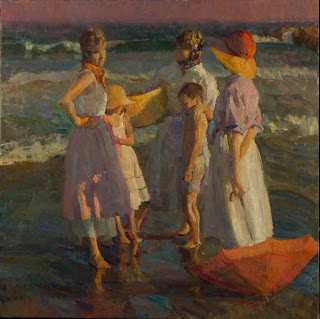
 These images were submitted Greenhouse Gallery's annual Salon show and made the cut. The second cut is in a month or so. I hope the confetti rains down on me like it did Drew Breeze.
Subscribe to:
Posts (Atom)
Subscribe To "Ruminating on the Profundities"


 Posts
All Comments
Posts
All Comments